Showing posts with label organization. Show all posts

Dec 14, 2025

The Risk of Unconventional Career Journey

Unconventional career journeys are risky

Often recruitment is numbers game and very staged. Recruiters are scanning through hundreds or even thousands of profiles and they have a specific criteria they compare those profiles against. Does the applicant have more than 5 years of experience in the craft? Have they been in supervisory role before? Have they managed managers? If any of the box goes without tick, in most cases they take the next application. 

Of course market situation also affects this, but if the company has got traction and there are enough applicants, this is how it goes. So without proper experience you don't even make it to the interview stage.

Box without a tick -> next applicant. 

There are less opportunities for generalists 

Because companies (and especially software engineering organisations) are traditionally built as they are, they follow this pattern: engineers (individual contributors) report to a team lead or engineering manager. These teams are then gathered into engineering departments, groups or tribes that are led by a director. Group of groups is then possibly called a unit and led by a vice president. The title for the highest ranked person depends on the company size, but could be "Head of", "Senior/Executive Vice President" or "Chief Techonology Officer".

When recruiters are filling these higher ranked roles, they are checking how the candidates have succeeded in the roles on the previous ladder. How successfully have they managed other managers or other directors? How long they have done that and in how many companies?

In this case people who have spent time in other functions (like being Product/Project Managers) or horizontal roles (like Agile Coach) have disadvantage. Their experience isn't immediately recognisable as beneficial for the role at hand. It's nice to have, but not fulfilling the requirements.

Sometimes the risk pays off 

There are roles that combine requirements from multiple crafts. Two possible mentions could be Product Engineer and Chief Product and Technology Officer (CPTO). Product Engineers are often people who are the first employees or founders of a tech startup. When you need to have someone who is able to think what the users need and turn that into a working application. With the latest advancements in AI and assistive technology, this might become more easy. If you have proper customer understanding and can explain it in words, tools like Copilot and Cursor can help you do the rest.

AI might change the game. 

CPTO role is another where two crafts come together. One needs to be knowledgeable about product management and be able to transform customer requirements into a roadmap and drive the implementation. Probably this role is more common in smaller companies, but could be considered also in bigger companies when a strong execution focus is required. And when the leadership team needs to be able to trust one person with the ownership of results. These roles can be opportunities also for generalists.

My story

Personally I feel like I stepped into the trap of being stuck on the generalist path for too long. I was once in a situation where I almost got to lead a department. I had carried out the organisational change, recruited the team leads and communicated what is going to happen. But then, when the new organisation was announced, I found myself somewhere else than in the head of this new department. Maybe the main learning was that one needs to be in really good terms with the decision makers in your 'homebase'. This is why I also see working abroad, far from the company headquarters, as a personal risk to anyone doing that. Out of sight, out of mind.

Don't forget to which organisation you report to. 

And I have had a bit too much agile coaching in my CV. People are offered positions that reflect what they have in their existing journey. Not what they are looking forward to doing next. That's why making a career shift is so difficult. If you want to do that, be prepared to take the long road. When you don't tick the previous boxes, (in most case) you won't stand a chance. 

May 16, 2020

Scaling Software Development

Software development is a team sport. It is true that even a single person can make huge contributions (like Linus Torvalds on Linux), but in most cases great results are produced by great teams. In this post I will concentrate on agile software development in a setup where own products are being made. I will try to tell how I would extend the team and what kind of tools or practices could be used.

Staffing the first team


Product Owner

Everything starts with an idea. A good rule of thumb is that there's a problem significant enough that it is worth solving. Before coding even a single line of code, make a hypothesis of the possible solution. Then validate it as fast as possible. For example Lean Startup practices might serve you in doing this. Having a Product Owner (PO) might be a good idea. PO can start collecting potential product feature ideas and requirements into a Product Backlog.

Architect

When you are pretty sure that you have an idea worth implementing and you start creating a team, maybe the first person to recruit is the architect. Someone who will have an overall technical vision about structure of the solution.

Coders

Next you probably want to add a few more coders to speed up the development. In the early phase of the product lifecycle it's tempting to divide the responsibilities so that there's a single person responsible for a part, but I would advise against doing so. It will limit the shared code ownership and most probably create bottlenecks. All parts of codebase should be familiar to more than one person.

Design and testing

Depending a bit on the case, next I would get a designer or a tester. If the solution needs to be operated by a user, I'd go with designer. If most of the magic happens in the backend and no-one cares how butt-ugly the product is, then first concentrate on making sure things work. Don't get a tester, but a person who is familiar with testing and can create automated tests. But testers think differently than coders, so better get one onboard.

Now you probably have quite standard software development team. Either get someone who has prior knowledge about agile software development to act as scrum/kanban master or select a person from the team that is most interested to learn the topic. With the help of this person the team will start an exodus to become a self-managing, self-organising cross-functional team that turns Product Backlog items into working software.

Scaling up


Splitting

Natural way to scale is to increase the team size by recruiting more and more coders and maybe domain experts. Once the team is so big that regular meetings like daily scrum are no longer efficient, it's time to start thinking about how to split the team.

When you split the team, think carefully how the new teams divide the responsibilities. Let the tech people decide what suits them best. When you have the second team, make sure that also contains all needed competences, including test automation.

Centralized competences

Some roles might not be needed full time in the development teams. It might make sense to centralize these to a different team that can support multiple dev teams. Architecture and design can be such skills that they can be in a common team.

When the work is divided between multiple teams it is also a sign that your operations need to raise to a new level of professionalism. It is a good idea to recruit someone to take ownership for the documentation. Security is also more important and maybe worth having someone concentrating on it. And since there are multiple teams (possibly) working on the same codebase, someone should spend a bit more time on setting up proper integration and deployment practice. Also it is worth thinking about how the teams coordinate and synchronize their work. Some scaling framework could be beneficial. For me Scaled Agile Framework is the most familiar. It also provides guidance on how to plan and execute things when you have multiple teams and also implement continuous improvement.

Get going

When you have recruited people to fill more than one development team and staffed another team has some centralized capabilities, it is time to plan how you shift the gear. This part requires a bit more effort on planning and discussion. I find it practical to have a person write down instructions that offer not too much, but enough details about how the new setup works. Then it is time to just agree on starting day and get going. Execute the initial plan, stop to reflect how did it go, adjust and repeat. That's how iterative and incremental practices work.

Tools

There are some tools that have become almost industry standard for supporting agile software development. Some tools have a lot of different features integrated to them and can handle a big part of the development pipeline. But I will give here an example of pretty traditional setup.

Backlog handling

For handling the Product Backlog, a pretty easy choice is Atlassian Jira. You can create and prioritise backlog items, track bugs and follow progress. If you are using Scrum, Jira offers possibilities for having burn down charts for your sprints. You can also easily visualise the workflow with kanban board and customize the columns to reflect your development process steps (like coding, code review, testing, etc.)

Version Control

The only version control tool that I would recommend is Git. There are multiple commercial tools that you can use that offer different additional benefits. Here are a few: GitHub, BitBucket, GitLab. Access rights control to the source code is probably the main thing, but maybe next in line is the possibility to use pull requests. Instead of pushing things straight to master you should consider a workflow that fosters shared code ownership and transparency. Code should be reviewed by someone else than the writer before merging.

Continuous Integration

Some Continuous Integration (CI) system will help you to automate your process. If the code needs to be compiled, the system will do it. In addition it can start the execution of automated tests, usually starting with unit tests. Some examples of CI systems are Jenkins, Drone, Bamboo, CircleCI, TeamCity and Travis.

Static Code Analysis

For static assessment of your codebase quality I would recommend adding a tool like SonarQube to your pipeline. It can help you measure how readable your code is and how good your test automation harness is. It will cover also security vulnerabilities.

Deployment 

Then you probably need some place to deploy your solution. Either you invest in hardware or you use cloud services. The most common public cloud platforms are AWS, Azure and Google Cloud. If you are using containers, you can orchestrate them with Kubernetes. If you can spend a bit more bucks, you can use an enterprise solution like OpenShift.

Documentation

Quite a standard way to build and maintain living documentation is through Confluence. Pages have version control and editing is very similar as in Wikipedia. They can be exported in multiple formats, such as pdf, word or html.

Possible pitfalls


Recruitment

If creating awesome applications and products that users love would be easy, everyone would do it. But it's not so simple. For starters, there's a shortage of skilled workforce. This means that people who know the craft also know their value. And since the whole world is getting digital, there are lots of companies that are willing and able to fight for the talent and offer high salaries and different perks. So, even if you can recruit a team, you might lose members because some other company 'buys them out'.

Culture

Another thing to understand is that the results that an organisation is able to produce are a lot more dependent on how well the people work together than how good the individuals are. It doesn't mean that you can achieve great results with mediocre people. But it does mean that even with highly skilled persons you can fail miserably if they don't get along. Culture makes a huge difference. If people feel safe to show their vulnerability and admit mistakes, everyone will benefit. With retrospectives and conscious continuous improvement efforts teams and teams of teams can raise to a whole new level of performance.

Edit 1: Added some sub-headers for easier navigation of topics.

Sep 6, 2017

Implementing Communities of Practice - In Practice

Lately I've been suffering from a writer's block, because I stumble to the fact that I've already written about the topic I have in mind. I've already written about Communities of Practice too, but now I have a different angle.


I'm currently working as a People Manager in a big finnish software & telco company. Title doesn't probably tell much, but in practice it means that I'm an administrative supervisor for ~30 persons. My closest colleague has a team of about same size, but we are strongly trying to operate as one big team with two supervisors. And to do it so that every person in our teams could discuss with either one of us and things would simply work.

At the same time I want to underline that we are serving the people, not the other way. In our field it's the experts who create all the customer value. They are the rockstars or boxing champs. We are the coaches and managers who make sure they can concentrate on where they excel.


But this is just the foundation. My duty is making sure we have the right staff and that there aren't any major impediments. I don't really manage the daily work, that guidance comes from the self-managing agile teams.

Our teams each serve a few customers. That enables us to get the benefit from working together for long enough to reach high performing state, and on the other hand, enough flexibility and variance so the work doesn't get boring. Teams are headed by a Technical Product Owner who handles the team's backlog.


With our team based organization structure alone we carry a big risk of slipping into silos. Self-managing and self-organizing teams are great, but really big benefits materialize when we can learn from each other. This is why we need the communities of practice (or in short CoP).

Before we reorganized ourselves into the current form, I headed the Technical Product Owner team. We had a community of practice. And I'm really proud to see they still have one even after I stopped facilitating the meetings. As a side note, it's a perfect way to acid test your coaching results. What happens when you're not around? If everything halts, you should maybe look into the mirror.


We have also other CoPs. One for designers, one for testers, one for architects and so on. Most of these communities are headed by a Technical Lead. These people are our most superb technical experts who are tasked with the goal of making our people competitive in the long run. They coach and mentor others in their technical field. It's actually a great opportunity for a younger professionals to grow.

And actually some of these communities extend beyond our unit boundaries. Our company has thousands of employees and our unit has sister units in other divisions. With similar organization structures we have been able to extend the sharing of knowledge. This work is largely unfinished, but already for example the designers have weekly meetings together and testing is coordinated across the whole company. Personally I'd like to grow our Agile Community, but without concrete shared projects it's difficult to find the common ground. But maybe we arrange some event together and see where it goes.


Jul 12, 2017

Designing an Organization

In software development there's a common phrase that you should employ the best people, treat them well and get out of their way. What is many times forgotten is the fact that even the best people need direction.

Photo by Rachael Gorjestani on Unsplash

If I think about a company/department/any organizational unit, I'd like to know what is its goal. (One could maybe also call it a Vision.) What is it trying to achieve? What is the purpose for having such unit? It's not mandatory, but beneficial, if the purpose for existence is noble or somehow larger than an individual.

Once you have found your purpose, share it with everyone. Talk about it continuously. Make it clear for all who are involved. Next, think about what matters would be needed to pursue the shared vision. What kind of organization would be most capable? What roles should different people take?


Then staff the organization. For each person, make it clear what is their purpose. How do they help in reaching the common goal? Do it in a transparent way so that others will also understand. Now you can let the magic happen. If you are in an expert organization, each person should know best what they should do. Or at least better than their bosses.

And don't think you're done. You will never be. Even if you don't like it, the world around you changes. You will need to adjust your goal. And your organization. Rinse and repeat.

Photo by Ryan Riggins on Unsplash

Apr 12, 2016

Paved with Good Intentions

How Local Optimization May Result in Failure 

Sometimes when you remove a rusty bolt from a system of nuts and bolts and clean it up, it may not fit the original context anymore. In the course of time the rust has become part of the system and should be also taken into account.


In a complex software legacy system this phenomenon may manifest when a certain subsystem is refactored or rewritten. Technically the new part may be superior and fulfill the original specifications, but the changes may still result in nasty regression issues. During the past years the layer of application logic has been built on top of the faulty behavior (the rust).


Same applies in organizational context. High-performance team may outrun the system around it. It may produce results faster than the other parts can consume. This can create queues and waste. Results can be even worse when the sub optimization happens on the unit level. For example when R&D is able to produce results faster than can be delivered or specified.

Usually increasing performance is desirable, but some gotchas should be avoided. If you  want to remedy the possible problems, I’d suggest a system view. Try to improve the overall flow of value through the system. Tweak the parts, but don’t fall for the local optimization. Aim to decrease the lead time and measure things from the customers’ perspective.


May 18, 2015

Answers to Open Questions

This time I'm writing a little differently structured blog post. Pierre Godts asked me the following questions at the Scaled Agile Framework group at LinkedIn. The question is related to the SAFe Case Study I wrote some time ago. So let's dive a bit deeper into some topics that were left our of the study.

Can you tell us more about the change at employee level? 

The change touched mostly people in the development. Previously all developers (coders and testers) had been in one big group and everyone shared the same supervisor. Work was organized around projects that were resourced from this pool of developers on a monthly basis. Projects were steered by people working in the business units.

After the change people were assigned to (Scrum) teams. Each team was appointed a Product Owner who was a member of a business unit. POs reported to the heads of business units (Chief Product Owners or Business Owners). Teams started to follow scrum way of working. During the same time our internal processes were also identified and written down. Release cycle was set to three months although we knew that we would probably face problems in the beginning.

Each team elected their own Scrum Master who then started to facilitate the events and see that we followed the scrum ceremonies. They were all certified (as were the POs). Scrum Master Community of Practice was also established and Chief Scrum Master started to facilitate it.

At the beginning Scrum Masters participated in a weekly Scrum of Scrums meeting. This was later replaced by a meeting that was between any member of each team. Scrum Masters started to have regular get-togethers where they discussed process related affairs and possible impediments that needed to be raised to company level.

What was their commitment to change? Were employees skeptical or not willing to change? 

People are all different. Some were more skeptical and some were more like early adopters. I belong to these guys who usually get excited about new things easily. But generally I'd say people were rather committed to the change. The previous state of the company was not really optimal either so I think there was a really fertile ground for some change.

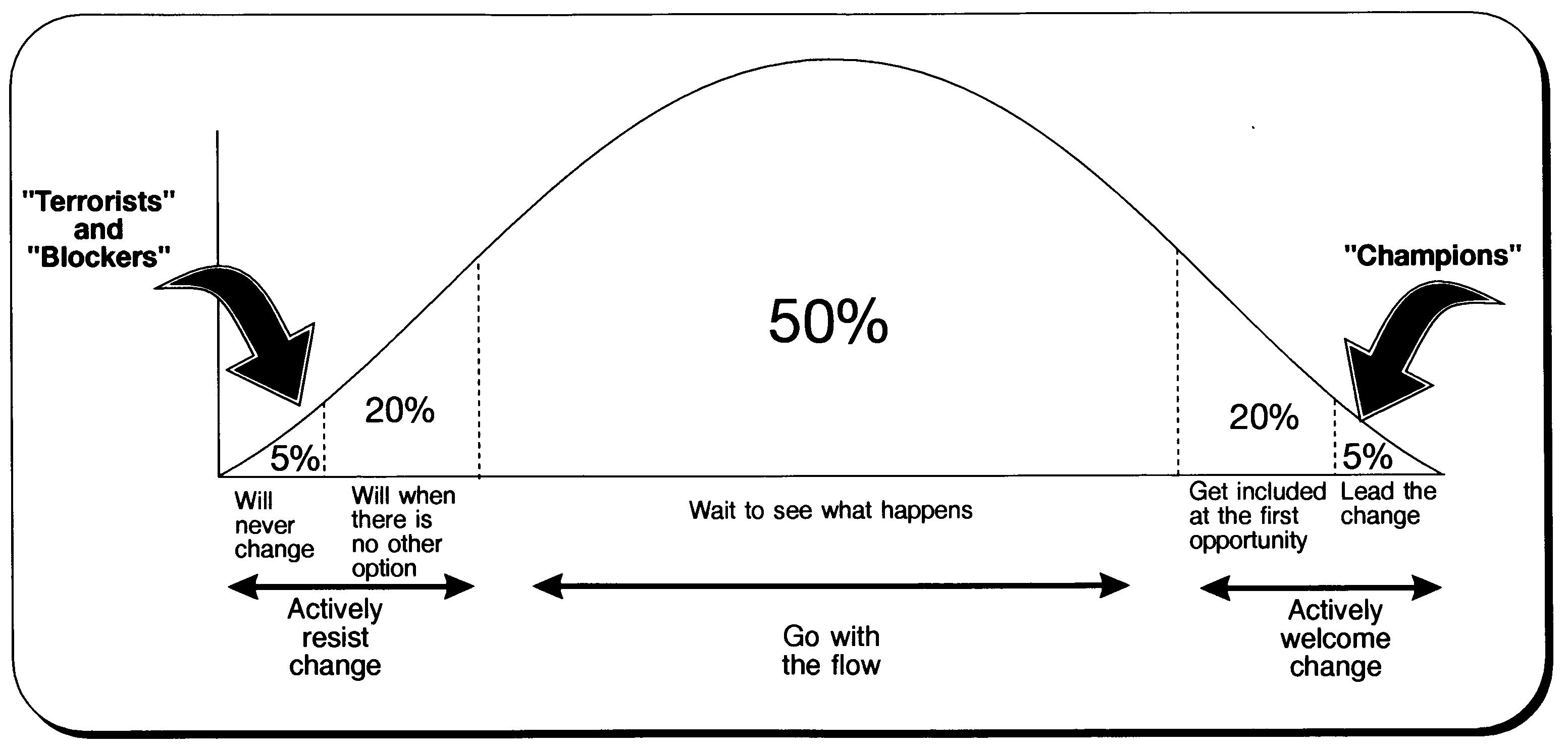
And as depicted in many change management related books the early and late majority just needed a bit more time and discussion. Maybe with some more coaching the change could have been faster. In our case teams were more or less left to figure out the steps themselves. But maybe we just did it with some luck.

Did some employees got fired? 

No. No employees got fired during the reorganization. But some didn't like the new way of working and decided to seek their destiny somewhere else. Some started their own company, some simply changed employer. I claim that quite many of these people had been thinking about the change already for a bit longer while. The reorganization was just the final nail into the coffin.

But one really positive thing is that some people have returned. They have seen the greener grass but understood that maybe it's due to more fertilization...

Were new employees hired? 

Yes. The company has been growing and new teams have been established during the past years.

Was there an increase in number of employees? 

Yes. Same as previous question.

What about stress level, increased or decreased? 

This is tough one. Depends. No-one probably misses the long death marches when we tried to get the release together after a year of development. Or the feeling that if I don't get this feature into the product the customers will need to wait for it for another year. (This would inevitably increase the scope creep and result in not so well tested additions at the really late part of the release cycle.)

But then the other side of the coin is that previously some developers had a really big areas of responsibility. This would mean that you could potentially save the whole company by fixing some issues and get credit from everyone. When you are working in a team, it's usually the team that gets the credit. But I see this again as one inevitable thing that happens when a company grows over certain limit.

What about the budgets/costs, controlled? 

Honestly I don't know the answer to this one. Probably the budget was controlled, but it was done in so smooth way that it was never evident. More I would say people didn't take the full benefit of their empowerment. When you have been just a resource and someone else has been managing you or your project for long enough, you don't really understand what it means when your boundaries are removed. It's a slow process to get people to see that "Hey, can I do this? Ok, wow, I can!" And it feels great. As an employee it's a bit scary. But as a supervisor I think it's great to empower others!


Did the use of Jira cause problems/difficulties?

Not really. With our distributed setup JIRA was really an essential tool. I like physical boards and post-its but with multiple sites it's a luxury you can't really afford. And when you accompany JIRA with other Atlassian tools you can get real transparency to the development. You can see whole chain from idea to source code to testing and finally to the product. And with documentation included.

Apr 16, 2014

Changing is Hard

I have come to the conclusion that resistance to change must be somehow built into us. Or at least it seems to be very natural. That's probably why there are countless of good and bad management books written about the topic. One of the best I know is Who Moved My Cheese? by Spencer Johnson. The plot in short is rather simple: there are two mice and two little people in a maze. Every day they go to a specific place in the maze to eat cheese. Until one day the cheese runs out and they need to adapt to the changed circumstances. Now I found out that there are even multiple videos made of the book. Here's one that I found:


Another short book about change management is John Kotter's Our Iceberg is Melting. This book is a fable telling about a penguin society. The penguins encounter a crisis when one of them notices that their iceberg is probably soon going to shatter. The book describes the steps for one possible way to carry out a change initiative. Amusingly, the reader may be able to recognize certain stereotypical (penguin) characters also in his/her own work environment.


Of course here I could pull Systems Thinking from my sleeve and simply say that it's the system that resists the change. The organizational culture developed during the years and the practices that people have gotten used to. Yes, true. It is the system that resists the change. And just like entropy, getting order to the chaos takes a lot of energy. The opposite happens without any extra effort.

In Systems Thinking management is responsible for the system, since they are the only ones who can modify it and change the rules. But sometimes it is hard to change the system even from the management direction. People are very reluctant to adopt to new ways and need constant reminding, gentle pushing and coaching. Repetition of the message seems to be really important. Otherwise people inevitably will revert to the old habits.

Books aside how do you carry out this in practice? I don't know. What I do is simply experimenting. Trying new ways of doing things and seeing how people react. Feedback is the key and sometimes a little provocation is required to wake people up a bit. And it is good to have a pragmatic colleague who pulls you out of your daily routines and reminds you to think about things that really matter: the big picture. (But it's so soothing to be busy and work on all those tiny details...)


Finally I'd like to share a video that tells about an interesting Agile organization. For me it could serve as a vision of where I'd like to steer my own organization. I think we are going to right direction, but Spotify has just taken a couple of more steps. Thank you Henrik Kniberg, you are an amazing fellow! (Also, just earlier today bought his latest book: Lean from the Trenches.)


Jan 29, 2014

Understanding the Whole

When a company is in the middle of an organizational change, it is sometimes difficult to understand your/others roles and the expectations. It's easy to stay with the comfortable old routines and do what you have always done. After all, you know what to do, you have done the same thing plenty of times before.

But here's the catch: what if things around you have changed? Things you know how to do might not deliver the value anymore the same way they used to. Or it can even be that the activity you keep on doing is creating a major pain for someone else in the organization.

Unfortunately I can't think of a good example where organs of living organisms were scrambled, but with organizations this can happen. And then it doesn't really work out well if the lungs still think they are fingers and forget to breath. It might have severe consequences even though they are still able to type like they used to. Like in the good old times.


Break the old habits! If you have been assigned to a new role, check what's really expected from you. Are you a muscle cell doing some heavy lifting or should you be concentrated on thinking about the future like the rest of the brain cells? How does your work affect the whole?

Jan 20, 2014

Knitting Processes Together

Interfacing is hard. Even if you take a simple example, (well, maybe not really that simple) a software development team and think about how the information flows from the original customer requirement to an implemented feature. Here I'm assuming that there is one Scrum Team developing one product.

First there is an interface between the customer and the Product Owner. The Product Owner interprets the requirements and maybe writes them down as a User Story in the Backlog. Then the Development Team starts working with the requirements and refine them with the Product Owner's assistance. Finally they implement a new piece of functionality. Something that is hopefully close to what the customer originally wanted.


Probably many have experienced cases where everything didn't go according to the customer's plans. Product or service did not meet the expectations. Fortunately this earlier mentioned development process can be improved by collaborating and working closely with the customer. But still, things tend to get a bit harder when you scale.

Depending on how you (or some others) choose to shape your organization, you might have a set of small start-ups where every team can do pretty much everything. But quite often your operations are modelled by separating different functions and processes. And I don't think it's always bad. I'm not really that into accounting, so I prefer someone else doing that for me. Or even thought I like interacting with customers, I'm perfectly fine with someone else closing the deals and me just providing some cool new functionality.

In addition to the different functional roles, there are processes applied in these functions. And these processes interact. In sales function there's the sales process and in R&D the software development process. One of the most common pitfalls in process oriented companies are the interfaces.


Even if you apply the idea of Continuous Improvement, you are usually just optimizing one process. And even if you have a state-of-the-art software development machinery it makes no difference if you cannot get the products to customers. Or if your sales or marketing cannot find your customers and make them aware of your superb new products.

The approach I have recently been involved with is the so called Value Chains. Instead of concentrating only on the individual processes, you take a helicopter view and think about the whole chain of actions from customer need to customer satisfaction. And then examine closely also the interfaces between the processes.

Of course this approach requires a healthy amount of collaboration between the functions. And maybe someone to pay attention to the whole. Quite often we tend to just stay in our little silos and see everyone outside as, well, outsiders. But get past that! Go to lunch with your buddies at sales or go have a cup of coffee with some people working in customer service. Or if you don't know anyone there yet, go and make some new friends!