Showing posts with label marketing. Show all posts

Mar 25, 2016

How Epics Flow Through Our Value Chain

If you are familiar with my previous posts, you probably know that I'm a Release Train Engineer. But as I've told, that's not all I do. Nowadays I'm not anymore Product Owner, but instead I try to concentrate more on being an owner for the value chain. So let me next try to describe the flow from idea to implementation.

When new (big) ideas are introduced, there are first a few prerequisites. There must be a business case. When we plan few years ahead, the idea must be profitable. Forecasted amount of revenue must exceed the direct development costs and the future maintenance costs. We also need to analyze roughly the size of the effort and amount of resources needed. Checking the time criticality and whether we have the capacity to squeeze the job through our pipeline in time are essential factors. It's also practical to check if the idea is in line with our strategy in general.


When all necessary groundwork analysis is done, our Portfolio Managemenent Team will make either a Go or No-Go decision. If the idea is approved, it will be added to a product Roadmap and scheduled for development. At this stage the idea is called Roadmap Theme. In SAFe the corresponding term is Epic.

The Roadmap Themes enter development through Release Planning (PI Planning). They are broken down into pieces that can be implemented within our release cycles and formed into JIRA Epics. After that the Scrum teams will further refine the Epics into Stories and tasks. Then they will work on them in an iterative and incremental fashion in Sprints.


Then comes the part that SAFe (to my knowledge) doesn't answer anymore. As in Scrum, there are lots of activities left for the organization to figure out. Also for releasing, there's usually a lot more than creating the software package. Even if you have managed to get your act so well together that you are practicing Continuous Delivery or Deployment (which we are not), you still need to communicate with your customers. People don't like surprises. Even if the changes are improvements, many times people will get pissed if they didn't know about the changes or asked for those.


For me the final touch for releasing are the accompanying activities. Do we have the marketing materials ready? What do we tell the customers? How do we sell them, whats the story? Sometimes we might need to train people. Or the very least we need to let the customers know about what they will get. And we need to distribute the same information internally. Otherwise communicating the new added value might be really difficult.


Product or solution might be only one layer inside a big onion. For some companies it's even relatively tiny compared to all other things. For example Supercell uses over 400 M$ on marketing. I don't think the budget for game development was anywhere near that sum.

In practice (in our setup) all these different activies for an Epic should be lead by Product Manager. S/he isn't the one who should do everything, but make sure they happen. As a Release Train Engineer and Value Chain Owner I try to ensure this happens. It is maybe worth mentioning that through SAFe, the activities related to writing software are rather well formulated and established. The cadence based thinking still needs to be implemented for these other activities.


Mar 21, 2016

Technology Adoption Life Cycle

I'm currently reading Crossing the Chasm by Geoffrey A. Moore. I have already before heard about the Technology Adoption Life cycle, but I've learned plenty of new things about it from this book.

Technology Adoption Curve


Figure 1. Without the Gaps.

Many times the technology adoption life cycle is presented as in Figure 1. Certain percentage of people (statistically) belongs to each of these groups. Only a very few belong to Innovators. Together with Early Adopters they make the early market. Early and Late Majority make 2/3 of the total sum. They form the Mainstream Market. And finally about one sixth belongs to the Laggards.

But actually this Bell curve isn't continuous. There are bigger and smaller gaps between the groups and that's where the interesting part begins. All the gaps have significance, and you need to change your approach when dealing with different groups, but the most significant gap is between Early Adopters and and Early Majority. That's why it has deserved the name Chasm.

Figure 2. The Chasm between Early and Late Market.

One thing that separates the different groups is that they are looking for different gains. And thus they cannot be used as references for the other groups. In the following I'll try to summarize what are the minimum requirements to make buying easy for the target groups. Figure 3 also contains information about in which order your company should focus on the different topics (Technology -> Product -> Market -> Company).

Innovators are interested in technology just for its sake. They are constantly looking for new things. Most probably you don't find them, they find you. They are willing to accept even buggy product, but they want it to be something totally new.
How to make buying easy: They want to be able to name it and understand what category it belongs to.

Visionaries (or Early Adopters) aren't as technology oriented. What they want is a big performance boost. Something that has not yet become mainstream and they can truly exploit before it becomes common knowledge. Usually Visionaries are career rockets and not people who are looking into spending the rest of their career in their current company and position.
How to make buying easy: They want to know who is going to use it and for what purpose.

Pragmatists are not looking for such big performance boosts. They want the new thing to replace something existing and doing that in a slightly better way. When they look for references, they want to see other Pragmatists. They are not willing to weed out any bugs, they want the product to simply work. Pragmatists and people in the late market want to support and buy from the market leader. They don't want to back up someone who might be going out of business.
How to make buying easy: They want to see competition and want to buy from the market leader.

Conservatives or the Late Majority will wait until they need to get that new thing. When they cannot do business anymore without that certain something. Usually they aren't that interested in technology. They might even be a little afraid of it. They will tolerate technology when they don't need to think about it.
How to make buying easy: They want to buy from an established company that can stay in the game also in the future.

Laggards aren't usually buying. But they can try to intercept your sales attempts. Try not to give any fuel for their fire!

Figure 3. Competitive Positioning Compass.

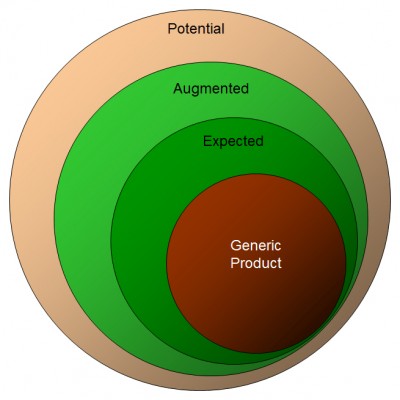
Whole Product

When you sell the product, the customer will form a mental image of it. Your sales promise most probably doesn't include everything your customer is expecting but you will none the less need to fill these expectations. In the below figures Generic Product represents the product as you have it. To be able to penetrate the mass market, the product must be supplemented with many other things and services. Only thus can it become a total solution, or in other words, the Whole Product.


This was only a short recap of some of the ideas I found in the book. As for any other book, if you got interested, please read the original. I really liked Crossing the Chasm. I look forward to reading Escape Velocity next.