Scaled Agile Framework offers a nice collection of Agile best practices. The Big Picture helps to visualize different concepts and ways of connecting them together. But one thing has always bothered me: there's no Customer in the picture. That's why I was positively surprised to read that the new version 4.0 will include also this one missing part.
I guess SAFe is mostly describing practices for the research and development activities. But once the development is completed and it's time to make a release, you usually want to give it to your customers. And in most companies there are functions that operate more closely in the customer front: sales and customer service. In smaller organizations these activities could be handled by product teams, but I assume that in a company that is big enough to benefit from the Scaled Agile Framework, these functions are separate.
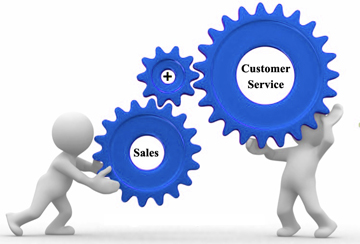
Actually, linking the development with sales activities is a non-trivial task. I would maybe first broaden the scope of the Product Management with practices from other frameworks, for example Pragmatic Marketing Framework. For me the sales activities are essentially trying to identify customer's needs, understand their problems and look for solutions to those in co-operation with them. If the current offering can fit the customer's process as it is, that's great. But as good solution could be adding the customer needs to Backlogs and fulfilling them in the future. And developing them together would make sure they fit their needs.
Another addition that I would like to see in SAFe is the role UX and design. In the article about Sprint Execution, there's the DBT (define, build, test) loop. I don't think that's enough anymore. I would like to bring this more towards the direction shown by Lean Startup, Lean UX and Design Thinking. Testing should happen with real customers to validate the hypothesis made before the development. Otherwise the road to hell can be paved with good intentions. You might assume that customers want something, but without testing your idea in practice you could be on a totally different page. (Actually I first missed this SAFe UX article. But I think it should be brought more to the Team level also.)
So those are the couple of additions that I would be glad to see in the future. Without Sales there's no money coming in. And without good UX there's probably no sales.
War stories about Agile implementation and scaling agility. My interpretation of Agile = applying common sense at work.
Apr 12, 2015
Mar 24, 2015
Building a New Product
As my opinion about perfect team structure has developed during the past years, so has my understanding of how awfully many different things need to be considered when building a new (desktop) software product.
As a coder I used to think that a random idea is a good starting point for a new feature. I still believe that making a crude and fast proto is a good idea, but there's maybe even better way. Before writing any code, make a sketch. Before implementing any functionality, test the idea with a real customer if possible. Then make variations to the design and iterate again. Do this for a while and you have less code to maintain and better understanding of what you maybe should be doing (Lean Startup and Lean UX).
Instead of just copying files between different computers, you might want to set up a version control system. There are many providers, but I can easily suggest Git. It's free, relatively easy to learn and so widely used that you can get help and skilled Git users easily.
"Well written code is its best documentation". I partially sign this statement but not totally. Useless comments that get out of date are just useless. But there might be general design ideas like what kind of inputs and outputs are expected and how different parts of the product are supposed to communicate together. Usually these higher level characterizations don't change much even though classes and modules can have much shorter life cycles. So some amount of (design) documentation is nice.
I like to promote test-driven development, because then you get a nice set of unit tests and presumably your life will be much easier later. It's like an investment into the future. Of course before you can write tests you need to implement a test framework. Fortunately for many modern languages these are often easily available. But if you are dealing with more exotic playground, you might need to invest a bit more time and effort. Never the less, having a unit test framework is an investment you seriously want to make.
It doesn't harm if testing and test automation is given a thought already at the design phase. You might want to have a tester involved.
If you are not intending to make your product open source (which is of course ok too) you should maybe build some kind of licensing system. There are many possible business models and maybe it also depends on if the users are expected to have internet access or not. But it's also an aspect to keep in mind.
Last but not least, after developing the product for a while you might remember that there should also be a way for the users to install the software. And it might have some prerequisites and dependencies that should be fixed before the happy user is able to start your product. You need an installer (WiX, NSIS, InstallShield). And if you haven't done that yet at this stage, you probably also want to set up a Continuous Integration system.
In addition to these, there are many more useful practices (coding and documentation conventions, manuals, 3rd party libraries, etc.), but I think I'm done here. The main point of this post was that there are really many things to consider when kicking up a new product. And even if you implement these it doesn't really guarantee anything yet. But at least you are not failing because you missed these things. :)
Mar 16, 2015
Mental Learnings
In this post I try to summarize what I learned from the final part of Thinking Fast and Slow. I've already written two posts about the subject (here and here), but I still want to share something about it (also I can then later refresh my own memory about these things).
Two Selves
Our mind works in two modes. There's the experiencing self that sits at the drivers seat. Everything that happens, happens to this poor fellow. Then there's the remembering self. After experiencing self has done it's part, remembering self decides how the event will be remembered. And surprisingly, this remembering self makes most of the decisions regarding your future.
When we experience something, we don't really remember the whole event. If you for example think about your past work week or last summer holiday (for Finns that might be many weeks), you don't remember all of it. You remember some moments. And actually if you experience something for a longer time, you don't really pay attention to the length. These two things are called duration neglect and peak-end rule. The book offers painful operations as an example. Afterwards you can't tell if you were in pain for 60 minutes or 80 minutes.
Suppose you go through painful procedure that lasts 60 minutes. Then suppose you repeat the same experience, but after 60 minutes you get painkiller and the operation lasts for another 20 minutes. If participants in these two experiments were asked which one they would repeat, majority would select the latter one. Although this means 20 extra minutes of pain! Are they mad? No, remembering self just doesn't care about the length (nor apparently about the suffering of experiencing self...)
Tip for presenters: aim to have some neat moment in your presentation and try to end with a bang. You will be remembered. Unfortunately it's easier said than done. Here's my attempt from this year's Scan-Agile.
Although people are generally risk averse, there are times when they are willing to take risks. If you are faced with only bad options, you will take risks. Another case is lottery or some other possibility to get a highly improbable big gain.
On the other hand when you are almost sure you will get something (95 percent probability), you are willing to settle for something less if you can get it for sure. Who Want's to Be a Millionaire works like that. You can anytime walk away with some much smaller price. This price increases as you get further in the game. And the bigger the sure price gets, the less tempting it will feel to take the risk of losing everything.
Then an example about possible losses. People don't just buy insurances; they buy ease of mind. Even if there's only a very small probability that your house will burn down, you are willing to get an insurance against that.
Finally, the outcome of an event is not everything that matters. The previous state plays a big role too. If two people have equal pay today you shouldn't simply assume they are equally happy about it. The other one might have received a big salary raise recently. The other one might have been dropped from a higher position and hence suffered a salary cut. Probably the first one feels joy, but other one might be looking for a new job.
I've covered only some things from the book that I found interesting. There's plenty of more. I can truly recommend reading this book. It makes you see things differently.
Tip for presenters: aim to have some neat moment in your presentation and try to end with a bang. You will be remembered. Unfortunately it's easier said than done. Here's my attempt from this year's Scan-Agile.
Sure Thing vs. Gamble
People dislike risk in most cases. In lotteries, people prefer getting sure but smaller gains versus bigger ones with some risk included. But situation depends a bit on how you frame it. 90 percent survivability rate sounds good. 10 percent mortality rate doesn't sound that good anymore. And if you say that 100 persons out of one thousand WILL DIE, that sounds just super bad. Unfortunately we humans are not immune to these framing effects and political and jury decisions can be influenced bending the words properly.On the other hand when you are almost sure you will get something (95 percent probability), you are willing to settle for something less if you can get it for sure. Who Want's to Be a Millionaire works like that. You can anytime walk away with some much smaller price. This price increases as you get further in the game. And the bigger the sure price gets, the less tempting it will feel to take the risk of losing everything.
Then an example about possible losses. People don't just buy insurances; they buy ease of mind. Even if there's only a very small probability that your house will burn down, you are willing to get an insurance against that.
Finally, the outcome of an event is not everything that matters. The previous state plays a big role too. If two people have equal pay today you shouldn't simply assume they are equally happy about it. The other one might have received a big salary raise recently. The other one might have been dropped from a higher position and hence suffered a salary cut. Probably the first one feels joy, but other one might be looking for a new job.
I've covered only some things from the book that I found interesting. There's plenty of more. I can truly recommend reading this book. It makes you see things differently.
Feb 26, 2015
Different Roles in a Full Stack Team
I don't think life is a box of chocolate. But it keeps surprising me never the less. In my case that means that I keep finding value in different activities. Such that I have not done myself or that my teams have not done very much. Maybe it could be best described as evolution.
I started as a coder. Although people didn't say it out loud (often), making modifications to 'the core' was more spectacular than making modifications to the graphical user interface. Mostly the illusion came from the siloed organizational structure. People who do something like to think they are somehow better than those 'other people' who do other things. Which is silly, of course, but still very human. :)
But anyway, I was a core developer. I worked with a big legacy core and could do magical things with it. I could create new features and implement new parts according to the details people gave me. Testing was something that was often mentioned as a valuable thing, but generally praise was given more to people who coded.
At some point I started to realize that testing is, in fact, important. My code wasn't perfect. My mind, the mind of a coder, was thinking how the system should be used. I didn't give a lot of thought to how the system wasn't supposed to be used. But many times users come up with very creative ways of doing things if the tool allows. When someone tested my code, it became better. It had less bugs. So testers were, and still are, useful.
When you work as a group or as a team it makes sense to have someone who makes sure that things happen. I don't think it needs to be a coach or Scrum Master (but it's ok too). More senior team member with right personality and skill-set can be even better.
Then lately, since Apple introduced iPhone, usability has become increasingly important. If the team has a dedicated designer, that's truly awesome. But even having usability built into the working practices is good. It's easy to get carried away with improving the algorithms and trying to write really clean code, but forget the fact that in the end someone should be able to use the system. And hopefully be able to do it without consulting a thick manual. So design and usability are important too.
Finally comes the role of architecture. It's possible to live without named architects, but I don't think it's possible to develop software with multiple teams if the architecture is neglected. Architecture might emerge, but it might not be the architecture you want to see. I dislike the idea of lifting architects to a podium or letting be live in an ivory tower. In my view architect could be a role. For the sake of clarity it would be just good that someone (even if team members take turns) will check occasionally the big picture and make sure all development efforts serve the grand plan. So I consider architects to be important too.
As a conclusion my view of different (necessary) roles in a team has changed over the years. Originally I thought only coders were needed, but now I know it takes a bigger family to grow flourishing software. And in this post I've intentionally scoped out many important business roles. Without proper Product Management and sales there probably won't be anything to develop. But let's leave something also for the future. :)
Feb 6, 2015
Do the Right Things Right and Fast
It's fascinating how sometimes some relatively simple picture can contain so much relevant information. I have been lately involved in strategy renewal and while doing that I saw a picture that I fell in love with.
My job is very much concentrated around improving software development processes. In essence it's about doing the things right. But many times I have thought that it doesn't really matter if you do things right if they are not the right things. You might write the most beautiful and simple code ever, but it makes no difference if no one cares about it. I feel this is often a problem with some open source projects. Okay, there might be open source with crappy code quality too, but usually the quality is on a really nice level.
Another case are commercial projects with tight deadlines. In those cases it's easily right things (someone, usually customer, is really interested about the results), but just fast. When coders are stretched, it is the quality that suffers.
By concentrating on the software production methods (Continuous Integration, Continuous Delivery) and good engineering practices (craftsmanship), one can only reach adequate results. One dimension is still missing.
Maybe the best non-perfect position to be is when you have a good portfolio (you are doing the right things) and you concentrate on your code quality (doing the things right). At this point you can still miss valuable market windows, but it can still work. Then you can start investing in the production methods and speed things up until you hit the sweet spot in the intersection of all the three dimensions.
I thing this later triplet of circles depicts the situation at practical level. When your Product Management is working properly, your Developers are applying good engineering practices and your development infrastructure is in order, you can expect awesome results. I'm not saying it's easy to achieve but definitely worth a try.
Jan 27, 2015
Personal Change Management
Despite the risk of sounding like an arrogant spoiled brat, I'll write this anyway. I have realized that moving from a developer role into management isn't just dancing on rose petals. And if you still try to participate in the development work, you experience brand new problems.
On one hand you feel like a member of the team. You participate in the work and you might even be good at it. And you know that it's value adding work. But due to your other duties you constantly feel that you are not doing enough. And you can't pair work as much you would like to, because it's rather time consuming. (Although I think the results are usually better than when working alone.)
On the other hand, you have your new management duties. In my case it means both being a supervisor and a Product Owner. A lot of coordination and simply communicating with other people are needed. I need to maintain the Product Backlog and sometimes even have unpleasant conversations.
I feel that upper management and the rest of the organization (and probably in the end even my team) would like me to concentrate on my managerial work. From systems point of view I understand it. The body benefits more if the lungs don't try to act like blood cells or brains as fingers. And I consciously try to do that. But it's a bit unnatural and I still feel like I'm pulled in two directions.
I'm not sure how common or rare this is, but I've perceived that I'm not the only one suffering from this problem. As a conclusion, I think the problem is mostly just between ears. When a person changes his/her role, it is more often that (s)he isn't able and/or willing to let go of the old duties. Unlearning is hard. But if you want to initiate change, you have to start from yourself.
Jan 21, 2015
What You See Is All There Is
I continue reading Daniel Kahneman's Thinking Fast and Slow. There's so much food for thought that my reading is slow. But I'm learning a lot more about how our minds work.
Our intuition about statistics is terrible. And we tend to jump into conclusions after very small hints. Things that we have clear memories or that have an emotional factor are easily exaggerated. And availability and easiness of retrieval from memory also play a significant role.
After each plane crash people begin the question the safety of flying. Images of burning planes and lives lost come to our minds. They get a lot of media attention. This forms a vicious circle. Newspapers write about things that the crowd is interested in. And the more we read about these things the more we will get. But it doesn't change the fact that the probability of a plane crash is really small.
Our minds want to see patterns and purpose in our environment. We are not that eager or willing to pick our brain for real data and facts if there's a coherent story available. Linda problem is a classical example:
In many cases the form of the question and availability of examples you can (easily) think of also affect the result. Consider the following:
Unfortunately I see the effects in software developers. (Same applies also to police.) When they are constantly dealing with only the negative sides (sw devs with bugs and police with crime), they get blind to the positive sides. What you see is all there is. Even if you have thousands of users and only a fraction experience problems. But if that's the only contact with the customers then it's really hard to resist the conclusion.
I tried to draw two sets of objects. One contains only nice, clean and unbroken things. The other one also has some flawed ones. If seen separately, people would probably put a lower price tag for the second set. Although it does contain all the elements from the first set plus a few extra. Logically thinking the second set is more valuable.
In software business one can easily get carried away with this. From developer point of you all you see are things that should be either fixed or improved. But you might also possess a huge asset that customers love. Otherwise you wouldn't probably even be employed.
Our intuition about statistics is terrible. And we tend to jump into conclusions after very small hints. Things that we have clear memories or that have an emotional factor are easily exaggerated. And availability and easiness of retrieval from memory also play a significant role.
After each plane crash people begin the question the safety of flying. Images of burning planes and lives lost come to our minds. They get a lot of media attention. This forms a vicious circle. Newspapers write about things that the crowd is interested in. And the more we read about these things the more we will get. But it doesn't change the fact that the probability of a plane crash is really small.
Our minds want to see patterns and purpose in our environment. We are not that eager or willing to pick our brain for real data and facts if there's a coherent story available. Linda problem is a classical example:
Linda is 31 years old, single, outspoken, and very bright. She majored in philosophy. As a student, she was deeply concerned with issues of discrimination and social justice, and also participated in anti-nuclear demonstrations.
Majority of people select the second alternative. It fits to the mental image. But if you think about it, or create a Venn diagram, you will understand that the second alternative is a mere subset of the first alternative.Which is more probable?
- Linda is a bank teller.
- Linda is a bank teller and is active in the feminist movement.
In many cases the form of the question and availability of examples you can (easily) think of also affect the result. Consider the following:
List three things that you'd like to change in your co-workers.I was first going to ask about kids, but maybe this is easier. Well, it's not that hard to come up with three things. Boy, your colleagues must be really irritating. But let's try another one:
Give 15 examples of situations where your work environment didn't fill your needs.Hopefully that wasn't as easy. First couple of things probably came easy but then you started to slow down (assuming you kept on after that). The outcome of this would be that things aren't really bad after all. The easier things come to our mind the more probable we think they are. And vice versa. This is in many cases rather confusing and even contradictory. People who are asked to find big list of positive things about some subject they like end up being less impressed about it. Even though they now actually know it has so many positive things!
Unfortunately I see the effects in software developers. (Same applies also to police.) When they are constantly dealing with only the negative sides (sw devs with bugs and police with crime), they get blind to the positive sides. What you see is all there is. Even if you have thousands of users and only a fraction experience problems. But if that's the only contact with the customers then it's really hard to resist the conclusion.
![]() |
| How much would you bet for each of these sets in an auction? |
I tried to draw two sets of objects. One contains only nice, clean and unbroken things. The other one also has some flawed ones. If seen separately, people would probably put a lower price tag for the second set. Although it does contain all the elements from the first set plus a few extra. Logically thinking the second set is more valuable.
In software business one can easily get carried away with this. From developer point of you all you see are things that should be either fixed or improved. But you might also possess a huge asset that customers love. Otherwise you wouldn't probably even be employed.
Labels:
biases,
book,
brain,
probability,
psychology,
thinking
Subscribe to:
Posts (Atom)