Showing posts with label adapt. Show all posts

Oct 11, 2015

Facing the Inevitable

Layoffs, bankruptcies and people losing their jobs seems to be almost like a trend nowadays. For the previous generations it was possible to graduate, get a job and finally retire with a gold watch after working in the same company for all of your career. If someone now has something similar in mind it almost feels naive.


Of course there are always exceptions. And probably there's big variation between different companies. But I think everyone needs to admit that things happen faster than before. Fortunes are made and lost in mere days, maybe even faster. Robots handle transactions at the stock market. One of the big dilemmas seems to be that there's a lot more data available than before, but it seems increasingly difficult to distill the important messages from the background noise. Do we have time and wisdom to understand what we measure?


I have adopted some rules of thumb from what I've read. I don't anymore think that people will spend all their lives in the same company. For my own company and team I try to create best possible circumstances for them to work. Create a system that they can feel connected with and achieve something. Exchange their free time to a hopefully competitive salary (I don't have much power over this) and to tasks that are intellectually challenging, foster their creativity and when ever possible, can be identified as things that move the company towards some greater goal.

Another thing to consider is situation when company needs to let some people go. It always feels bad. But sometimes it is inevitable. I think about Nokia as an example. If you manufacture normal, non-smart phones and people don't buy them anymore, the situation is tough. There's no easy way to increase the sales. Maybe you can find a new market where people still would prefer these 'old school' phones, but that doesn't change the fact that globally the demand for them has gone down. And will not go up anymore in the foreseeable future. And if your organization consist mainly of experts in this field, management doesn't have a multitude of options. You can wait until your bank account is empty, but in the end the result will by inevitable and ugly.


In the end the choices are to go out of business or face the facts and adapt. Things that worked in the past do not work anymore and you need to come up with something new. You will need to develop new competencies and be bold enough to let go of the past.

For some this is a cruel message. For some it can be a wake up call. My best advice for everyone could be to keep challenging yourself and to learn new things. If you learned to do something 10 years ago and continue to do the same year after year... one day your services may not be needed anymore.

Stay curious and find out new things. Experiment. Stay agile and adapt to the changing environment. Learn everyday!

Jul 12, 2015

Loops of Learning

I'm currently reading a book about Organizational Patterns of Agile Software Development. In addition to the interesting patterns I was especially attracted to the chapter about anthropological foundations. The book also opened my eyes to see that processes alone are not enough. I've written about this before, but my view was reinforced once more.


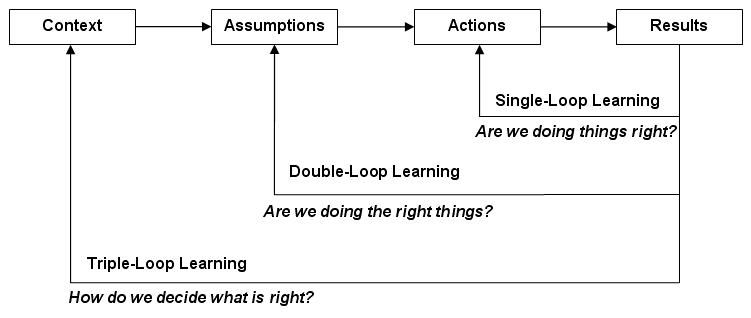
Continuous improvement with processes usually only deal with Single-Loop Learning. We inspect the results of our immediate reactions and then make corrections. Usually this is ok for a team that is building software in iterations. It's about following the rules. But when we go a bit higher, it maybe isn't enough anymore.


The second level, Double-Loop Learning was introduced to me by the Lean Startup book. In that method we still make small modifications as often as possible to learn fast, but we also can choose to either pivot or persevere. Do we want to keep on chasing the selected goal or should we select another target? Already this felt to me like something really awesome. Someone has even described the ideas of Lean Startup as possessing super powers. (I wouldn't maybe go that far, but it's a good book.) On this second level we create more insights about our actions. It can be also characterized as Systems Thinking.


But I wasn't aware, at least consciously, of the next level: Triple-Loop Learning until now. Jurgen Appelo writes about it in his blog post and Thorsten Gragert's wiki site offers a nice a summary including the below figure. The 3rd level deals with principles. In organizational context I'd associate it with company values and learning about learning.

Figure adopted from www.thorsten.org

By digging a bit more I found this article about Learning organizations. Interesting concept. They have the following five main features:
  • systems thinking
  • personal mastery
  • mental models
  • shared vision
  • team learning
I think I need to give this a lot more thought. And try to lead my organization further on this path. Maybe I will coin a term #BeyondAgile. :)

And finally, as a somewhat sidestep, I'll share a some tips I have spotted from many successful organizations:
  1. Dream big
  2. Hire the best people (who share your dream)
  3. Stay out of their way
  4. Share the success